
Secure Email and File-Sharing Platform
Virtru is a secure email and file-sharing platform that allows users to send encrypted email messages and attachments through Gmail. Virtru helps protect sensitive, confidential, and regulated information so that only authorized recipients can access it.
Use Virtru when sending information that should not be shared publicly or accessed by unintended recipients.

When Should I Use Virtru?
Use Virtru when sending emails or attachments that include:
- Personally Identifiable Information, also known as PII
- Student education records or FERPA-protected information
- Accommodation, disability services, health-related, or counseling-related information
- HR, payroll, legal, financial, or institutional records
- Confidential department, committee, research, or business materials
- Any message where access may need to be restricted, expired, or revoked later
If you are unsure whether an email should be encrypted, use Virtru or contact the IT Help Desk, your supervisor, or the appropriate compliance office for guidance.
Getting Started
To use Virtru’s secure email, you must be using Google Chrome. If you are using a browser other than Google Chrome, you will be unable to use this service.

Once the extension has been added to Chrome, return to your Gmail inbox. Gmail should refresh on its own. If it does not, close out of Gmail and relaunch it in Google Chrome.
Once you are there, you should see a screen similar to the one below:
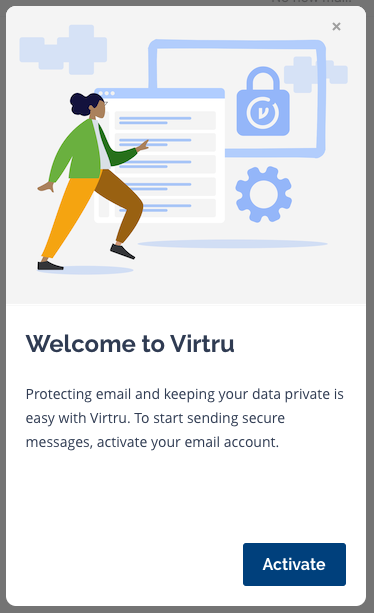
On this screen, click Activate.
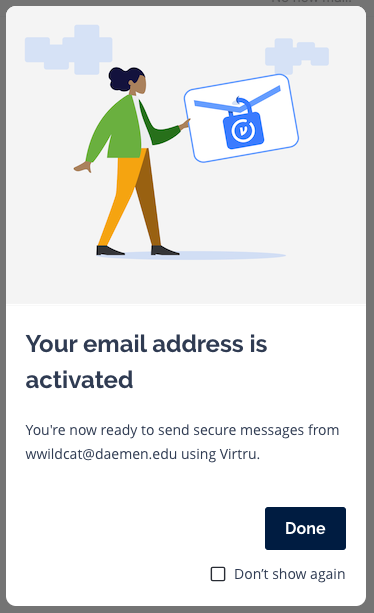
Click Done.
You are now ready to start using the secure email service from Virtru.
When you compose a new message, a new Virtru option will be shown. You can toggle encryption on or off using the switch.
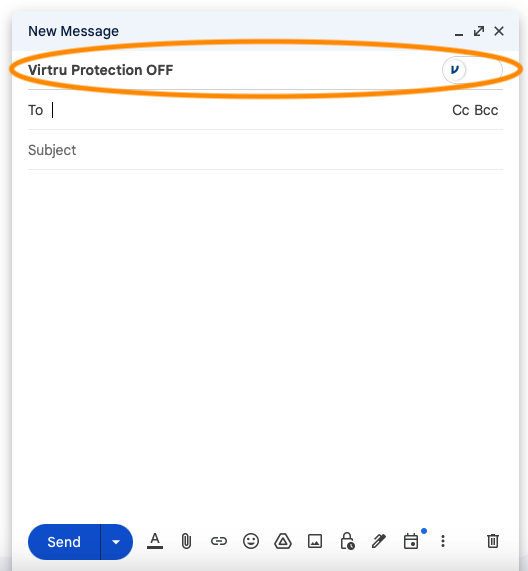
Toggle Virtru on and off
When encrypted, the top of the Compose Message window will turn blue, indicating that the message will be protected.
Sending a Secure Email
To send an encrypted email using Virtru:
- Open Gmail in Google Chrome.
- Click Compose.
- Add the recipient’s email address in the To field.
- Enter a subject line.
- Avoid placing sensitive details in the subject line.
- For example, use “Secure Document for Review” instead of including a student name, ID number, grade, or confidential topic.
- Write your message.
- Attach any files that need to be sent securely.
- Turn the Virtru toggle on.
- Confirm that the top of the Compose Message window turns blue.
- Review the recipient, message, and attachments carefully.
- Click Send.
Each person listed in the To field will receive an email notifying them that a secure message is waiting for them.
Automatic Encryption for Sensitive Information
Note: If the body of the message contains any PII (Personally Identifiable Information) or Sensitive Information, Virtru may automatically encrypt the message when you click Send to protect its contents.
Even when automatic encryption is available, it is still best practice to manually enable Virtru whenever you know the message contains sensitive or confidential information.
Sending Secure Attachments
Virtru can also protect files attached to an email.
To send a secure attachment:
- Compose your email in Gmail.
- Attach the file as you normally would.
- Turn the Virtru toggle on.
- Confirm that the compose window turns blue.
- Send the message.
Recipients may need to verify their identity before viewing or downloading protected attachments.
Optional Security Controls
Depending on your account settings, Virtru may provide additional security options. These may include:
- Disable Forwarding: Prevents recipients from forwarding the protected message.
- Set Expiration: Limits how long the recipient can access the message.
- Revoke Access: Removes access to the message after it has been sent.
- Watermarking: Adds identifying information to discourage screenshots or unauthorized sharing.
Use these controls when sending highly sensitive information or when access should be limited to a specific time period.
Revoking Access to a Sent Email
One advantage of Virtru is the ability to remove access after an email has been sent.
If you sent a protected message to the wrong person or access is no longer appropriate:
- Open Gmail.
- Go to your Sent folder.
- Open the Virtru-protected message.
- Locate the Virtru controls for that message.
- Select Revoke Access.
- Confirm the action.
After access is revoked, the recipient will no longer be able to open the protected content.
If sensitive information was sent to the wrong recipient, revoke access immediately and follow your department’s or institution’s data security reporting procedures.
How Recipients Open a Secure Message
Recipients will receive an email notifying them that a secure message is waiting.
To open the message, recipients should:
- Open the email notification.
- Click the secure message link, unlock button, or Virtru prompt.
- Verify their identity if prompted.
- View the message in the secure Virtru reader or directly in their inbox, depending on their setup.
Recipients usually do not need to install Virtru. However, they must use the same email address that received the protected message.
FERPA and Data Privacy Best Practices
When sending student information or other sensitive data by email:
- Use Virtru for FERPA-protected student education records.
- Send student information only to recipients with a legitimate educational interest.
- Avoid including sensitive student details in the subject line.
- Double-check recipient addresses before sending.
- Attach only the files the recipient needs.
- Use expiration dates or disable forwarding for highly sensitive information.
- Revoke access immediately if a message is sent to the wrong person.
- Contact the Registrar, IT Help Desk, or supervisor if you are unsure whether information may be shared.
Troubleshooting
I do not see the Virtru option in Gmail.
Try the following:
- Confirm that you are using Google Chrome.
- Confirm that the Virtru Chrome extension is installed and enabled.
- Refresh Gmail.
- Close and reopen Google Chrome.
- Sign out and sign back in to your Gmail account.
- Contact the IT Help Desk if the Virtru option still does not appear.
Gmail did not refresh after installing the extension.
Try closing Gmail and reopening it in Google Chrome. If the issue continues, restart Chrome and return to your Gmail inbox.
The recipient cannot open the secure message.
Ask the recipient to:
- Use the same email address that received the secure message.
- Complete any email verification steps.
- Try opening the message in a different browser.
- Check spam or junk folders for verification messages.
- Contact their organization’s IT support if secure message links are blocked.
The attachment will not open.
Confirm that:
- Virtru was turned on before sending.
- The recipient is using the correct email account.
- The message has not expired.
- The recipient’s access has not been revoked.
- The file type and file size are permitted by email policies.